Welcome to our global website
Or choose another language
Article
If an accident occurs and a corrosive substance gets into your eye, every second counts. It is crucial to rinse the eye immediately, preferably with a buffered rinsing solution, and to continue rinsing for an extended period. The most dangerous are strongly alkaline substances such as caustic soda, but certain acids can also cause serious eye damage.
Anders Behndig is a professor and senior consultant at Umeå University Hospital and an expert on the front part of the eye. During his years as an eye specialist, he has met several patients who have had the misfortune of getting corrosive substances into their eyes, either at work or at home. And it is the patients who have had the opportunity to quickly rinse their eyes that have fared the best.
“The most important thing when you get a corrosive substance in your eye is to start rinsing the eye immediately. It is a matter of seconds after the injury has occurred, and it is important to keep rinsing for a long time. This is crucial for determining whether the eye and vision can be saved.”
The pH value of the eyes is neutral, 7.4. At a pH of under 7.2 or above 7.8, you can already begin to feel an unpleasant irritating sensation. A pH below 4 or above 10, will result in serious injury.
“The most dangerous are corrosive substances, first and foremost alkaline ones with a pH value above 7.8. At home, you will usually find these in the cleaning cupboard, such as bleach, which is also called caustic soda, and some dishwasher detergents. In the workplace, the most common corrosive substances are alkalis and acids, such as bleach, sodium carbonate and ammonia,” says Anders Behndig and adds that even some acids, such as hydrochloric, nitric and sulphuric acids are also dangerous for the eyes.
How long you should rinse depends on a number of things ranging from the type of corrosive substance you are dealing with, and when the injury occurred before you started rinsing. The type of rinsing solution used is also very important.
“If you start rinsing the eye quickly and continue rinsing for a long time, preferably 15 minutes or more, the body has a better chance of healing the injury. The longer, the better. If you suspect a serious injury, you should keep rinsing until you are under medical care,” says Anders Behndig.
It is also important to rinse with a generous, steady flow to quickly lower the concentration of the corrosive substance and physically remove it from the eye.
“The amount of liquid used to rinse the eye is of great importance for how quickly a corrosive substance is diluted and the pH is restored. The flow of liquid is also crucial for the purely mechanical removal of the corrosive substance from the eye, especially if it contains solid particles, which is not uncommon. A high flow cannot be achieved with, for example, spray bottles or similar devices; instead, a strong, continuous flow of liquid is required to achieve the intended effect,” says Anders Behndig.
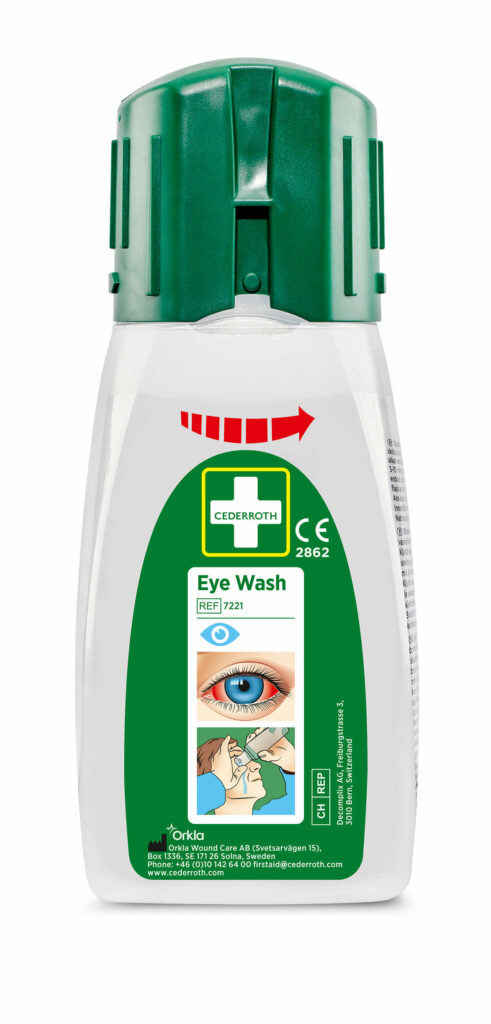
The best thing to use is a so-called buffered rinsing solution. This is a solution that neutralises the pH in the eye more quickly than regular water or saline solution.
“If you get a strong corrosive substance in your eye, it is not enough to just rinse it with water or saline solution, because this only has a mechanical effect. A buffered solution also neutralises the pH and helps return it closer to the eye’s natural pH,” says Anders Behndig.
“You can’t know this straight away. It can take days, sometimes weeks, before you can know how badly damaged the eye is. This is partly because the healing process after damage caused by an alkaline substance is what we call ‘biphasic’: the eye first becomes inflamed and red, then it can calm down after a few days and appear better, only to worsen significantly again,” says Anders Behndig.
Chemical eye injuries can destroy, in whole or in part, the biological tissues of the eye. This can result from extreme pH levels or from substances with oxidising or reducing properties.
“The worst injuries occur after accidents involving alkaline substances, as they can penetrate deeply and damage the eye’s stem cells so that the cornea becomes cloudy and unclear, or they damage the conjunctiva so that adhesions form between it and the eyelid. This cannot be repaired with transplantation. Fortunately, these stem cells are deep enough that you can rinse away the dangerous substance before it damages them, allowing the eye to heal. It all depends on how quickly you start rinsing!”
Text: Karin Cedronius